Tag Archives: fantasy

ADVENT CALENDAR DAY 10

Standard

The Ghost smiled thoughtfully, and waved its hand: saying as it did so, `Let us see another Christmas.’

Scrooge’s former self grew larger at the words, and the room became a little darker and more dirty. The panels shrunk, the windows cracked; fragments of plaster fell out of the ceiling, and the naked laths were shown instead; but how all this was brought about, Scrooge knew no more than you do. He only knew that it was quite correct; that everything had happened so; that there he was, alone again, when all the other boys had gone home for the jolly holidays.

He was not reading now, but walking up and down despairingly.

Scrooge looked at the Ghost, and with a mournful shaking of his head, glanced anxiously towards the door.

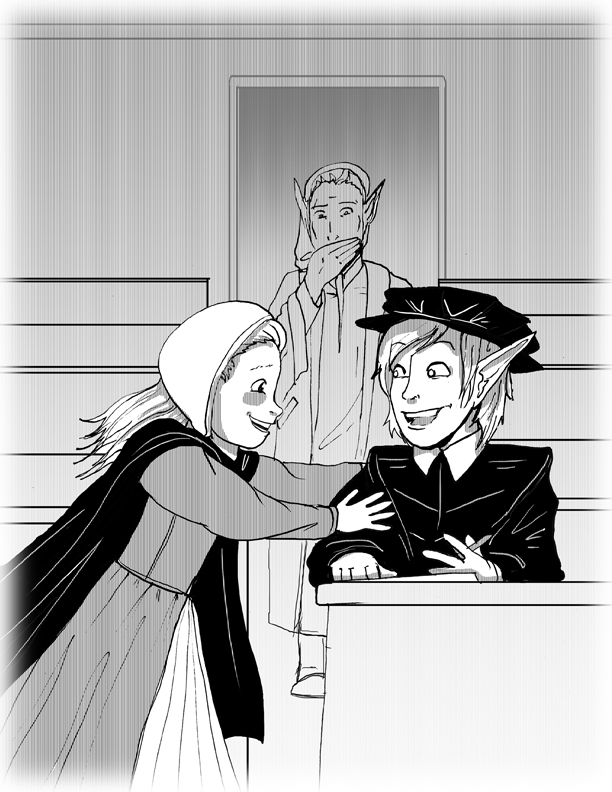
It opened; and a little girl, much younger than the boy, came darting in, and putting her arms about his neck, and often kissing him, addressed him as her `Dear, dear brother.’

`I have come to bring you home, dear brother.’ said the child, clapping her tiny hands, and bending down to laugh. `To bring you home, home, home.’

`Home, little Fan.’ returned the boy.

cc_09

`I have come to bring you home, dear brother.’ said the child

`Yes.’ said the child, brimful of glee. `Home, for good and all. Home, for ever and ever. Father is so much kinder than he used to be, that home’s like Heaven. He spoke so gently to me one dear night when I was going to bed, that I was not afraid to ask him once more if you might come home; and he said Yes, you should; and sent me in a coach to bring you. And you’re to be a man.’ said the child, opening her eyes,’ and are never to come back here; but first, we’re to be together all the Christmas long, and have the merriest time in all the world.’

`You are quite a woman, little Fan.’ exclaimed the boy.

She clapped her hands and laughed, and tried to touch his head; but being too little, laughed again, and stood on tiptoe to embrace him. Then she began to drag him, in her childish eagerness, towards the door; and he, nothing loth to go, accompanied her.

A terrible voice in the hall cried. `Bring down Master Scrooge’s box, there.’ and in the hall appeared the schoolmaster himself, who glared on Master Scrooge with a ferocious condescension, and threw him into a dreadful state of mind by shaking hands with him. He then conveyed him and his sister into the veriest old well of a shivering best-parlour that ever was seen, where the maps upon the wall, and the celestial and terrestrial globes in the windows, were waxy with cold. Here he produced a decanter of curiously light wine, and a block of curiously heavy cake, and administered instalments of those dainties to the young people: at the same time, sending out a meagre servant to offer a glass of something to the postboy, who answered that he thanked the gentleman, but if it was the same tap as he had tasted before, he had rather not. Master Scrooge’s trunk being by this time tied on to the top of the chaise, the children bade the schoolmaster good-bye right willingly; and getting into it, drove gaily down the garden-sweep: the quick wheels dashing the hoar-frost and snow from off the dark leaves of the evergreens like spray.

`Always a delicate creature, whom a breath might have withered,’ said the Ghost. `But she had a large heart.’

`So she had,’ cried Scrooge. `You’re right. I will not gainsay it, Spirit. God forbid.’

`She died a woman,’ said the Ghost, `and had, as I think, children.’

`One child,’ Scrooge returned.

`True,’ said the Ghost. `Your nephew.’

Scrooge seemed uneasy in his mind; and answered briefly, `Yes.’

ADVENT CALENDAR DAY 9

Standard

8 Perhaps, Scrooge could not have told anybody why, if anybody could have asked him; but he had a special desire to see the Spirit in his cap; and begged him to be covered.

`What.’ exclaimed the Ghost, `would you so soon put out, with worldly hands, the light I give. Is it not enough that you are one of those whose passions made this cap, and force me through whole trains of years to wear it low upon my brow.’

Scrooge reverently disclaimed all intention to offend or any knowledge of having wilfully bonneted the Spirit at any period of his life. He then made bold to inquire what business brought him there.

`Your welfare.’ said the Ghost.

Scrooge expressed himself much obliged, but could not help thinking that a night of unbroken rest would have been more conducive to that end. The Spirit must have heard him thinking, for it said immediately:

`Your reclamation, then. Take heed.’

It put out its strong hand as it spoke, and clasped him gently by the arm.

`Rise. and walk with me.’

It would have been in vain for Scrooge to plead that the weather and the hour were not adapted to pedestrian purposes; that bed was warm, and the thermometer a long way below freezing; that he was clad but lightly in his slippers, dressing-gown, and nightcap; and that he had a cold upon him at that time. The grasp, though gentle as a woman’s hand, was not to be resisted. He rose: but finding that the Spirit made towards the window, clasped his robe in supplication.

`I am mortal,’ Scrooge remonstrated, `and liable to fall.’

`Bear but a touch of my hand there,’ said the Spirit, laying it upon his heart,’ and you shall be upheld in more than this.’

As the words were spoken, they passed through the wall, and stood upon an open country road, with fields on either hand. The city had entirely vanished. Not a vestige of it was to be seen. The darkness and the mist had vanished with it, for it was a clear, cold, winter day, with snow upon the ground.

`Good Heaven!’ said Scrooge, clasping his hands together, as he looked about him. `I was bred in this place. I was a boy here.’

The Spirit gazed upon him mildly. Its gentle touch, though it had been light and instantaneous, appeared still present to the old man’s sense of feeling. He was conscious of a thousand odours floating in the air, each one connected with a thousand thoughts, and hopes, and joys, and cares long, long, forgotten.

`Your lip is trembling,’ said the Ghost. `And what is that upon your cheek.’

Scrooge muttered, with an unusual catching in his voice, that it was a pimple; and begged the Ghost to lead him where he would.

`You recollect the way.’ inquired the Spirit.

`Remember it.’ cried Scrooge with fervour; `I could walk it blindfold.’

`Strange to have forgotten it for so many years.’ observed the Ghost. `Let us go on.’

They walked along the road, Scrooge recognising every gate, and post, and tree; until a little market-town appeared in the distance, with its bridge, its church, and winding river. Some shaggy ponies now were seen trotting towards them with boys upon their backs, who called to other boys in country gigs and carts, driven by farmers. All these boys were in great spirits, and shouted to each other, until the broad fields were so full of merry music, that the crisp air laughed to hear it.

`These are but shadows of the things that have been,’ said the Ghost. `They have no consciousness of us.’

cc_08

The jocund travellers came on; and as they came, Scrooge knew and named them every one.

The jocund travellers came on; and as they came, Scrooge knew and named them every one. Why was he rejoiced beyond all bounds to see them. Why did his cold eye glisten, and his heart leap up as they went past. Why was he filled with gladness when he heard them give each other Merry Christmas, as they parted at cross-roads and bye-ways, for their several homes. What was merry Christmas to Scrooge. Out upon merry Christmas. What good had it ever done to him.

`The school is not quite deserted,’ said the Ghost. `A solitary child, neglected by his friends, is left there still.’

Scrooge said he knew it. And he sobbed.

They left the high-road, by a well-remembered lane, and soon approached a mansion of dull red brick, with a little weathercock-surmounted cupola, on the roof, and a bell hanging in it. It was a large house, but one of broken fortunes; for the spacious offices were little used, their walls were damp and mossy, their windows broken, and their gates decayed. Fowls clucked and strutted in the stables; and the coach-houses and sheds were over-run with grass. Nor was it more retentive of its ancient state, within; for entering the dreary hall, and glancing through the open doors of many rooms, they found them poorly furnished, cold, and vast. There was an earthy savour in the air, a chilly bareness in the place, which associated itself somehow with too much getting up by candle-light, and not too much to eat.

They went, the Ghost and Scrooge, across the hall, to a door at the back of the house. It opened before them, and disclosed a long, bare, melancholy room, made barer still by lines of plain deal forms and desks. At one of these a lonely boy was reading near a feeble fire; and Scrooge sat down upon a form, and wept to see his poor forgotten self as he used to be.

Not a latent echo in the house, not a squeak and scuffle from the mice behind the panelling, not a drip from the half-thawed water-spout in the dull yard behind, not a sigh among the leafless boughs of one despondent poplar, not the idle swinging of an empty store-house door, no, not a clicking in the fire, but fell upon the heart of Scrooge with a softening influence, and gave a freer passage to his tears.

The Spirit touched him on the arm, and pointed to his younger self, intent upon his reading. Suddenly a man, in foreign garments: wonderfully real and distinct to look at: stood outside the window, with an axe stuck in his belt, and leading by the bridle an ass laden with wood.

`Why, it’s Ali Baba.’ Scrooge exclaimed in ecstasy. `It’s dear old honest Ali Baba. Yes, yes, I know. One Christmas time, when yonder solitary child was left here all alone, he did come, for the first time, just like that. Poor boy. And Valentine,’ said Scrooge,’ and his wild brother, Orson; there they go. And what’s his name, who was put down in his drawers, asleep, at the Gate of Damascus; don’t you see him. And the Sultan’s Groom turned upside down by the Genii; there he is upon his head. Serve him right. I’m glad of it. What business had he to be married to the Princess.’

To hear Scrooge expending all the earnestness of his nature on such subjects, in a most extraordinary voice between laughing and crying; and to see his heightened and excited face; would have been a surprise to his business friends in the city, indeed.

`There’s the Parrot.’ cried Scrooge. `Green body and yellow tail, with a thing like a lettuce growing out of the top of his head; there he is. Poor Robin Crusoe, he called him, when he came home again after sailing round the island. `Poor Robin Crusoe, where have you been, Robin Crusoe.’ The man thought he was dreaming, but he wasn’t. It was the Parrot, you know. There goes Friday, running for his life to the little creek. Halloa. Hoop. Hallo.’

Then, with a rapidity of transition very foreign to his usual character, he said, in pity for his former self, `Poor boy.’ and cried again.

`I wish,’ Scrooge muttered, putting his hand in his pocket, and looking about him, after drying his eyes with his cuff: `but it’s too late now.’

`What is the matter.’ asked the Spirit.

`Nothing,’ said Scrooge. `Nothing. There was a boy singing a Christmas Carol at my door last night. I should like to have given him something: that’s all.’
ADVENT CALENDAR DAY 8

Standard

START AT BEGINNING

Stave Two: The First of the Spirits

When Scrooge awoke, it was so dark, that looking out of bed, he could scarcely distinguish the transparent window from the opaque walls of his chamber. He was endeavouring to pierce the darkness with his ferret eyes, when the chimes of a neighbouring church struck the four quarters. So he listened for the hour.
To his great astonishment the heavy bell went on from six to seven, and from seven to eight, and regularly up to twelve; then stopped. Twelve. It was past two when he went to bed. The clock was wrong. An icicle must have got into the works. Twelve.

He touched the spring of his repeater, to correct this most preposterous clock. Its rapid little pulse beat twelve: and stopped.

`Why, it isn’t possible,’ said Scrooge, `that I can have slept through a whole day and far into another night. It isn’t possible that anything has happened to the sun, and this is twelve at noon.’

The idea being an alarming one, he scrambled out of bed, and groped his way to the window. He was obliged to rub the frost off with the sleeve of his dressing-gown before he could see anything; and could see very little then. All he could make out was, that it was still very foggy and extremely cold, and that there was no noise of people running to and fro, and making a great stir, as there unquestionably would have been if night had beaten off bright day, and taken possession of the world. This was a great relief, because “Three days after sight of this First of Exchange pay to Mr. Ebenezer Scrooge on his order,” and so forth, would have become a mere United States security if there were no days to count by.

Scrooge went to bed again, and thought, and thought, and thought it over and over, and could make nothing of it. The more he thought, the more perplexed he was; and, the more he endeavoured not to think, the more he thought.

Marley’s Ghost bothered him exceedingly. Every time he resolved within himself, after mature inquiry that it was all a dream, his mind flew back again, like a strong spring released, to its first position, andpresented the same problem to be worked all through, “Was it a dream or not?”

Scrooge lay in this state until the chime had gone three-quarters more, when he remembered, on a sudden, that the Ghost hadwarned him of a visitation when the bell tolled one. He resolved to lie awake until the hour
was passed; and, considering that he could no more go to sleep than go to heaven, this was, perhaps, the wisest resolution in his power.

The quarter was so long, that he was more than once convinced he must have sunk into a doze unconsciously, and missed the clock. At length it broke upon his listening ear.

“Ding, dong!”

“A quarter past,” said Scrooge, counting.

“Ding, dong!”

“Half past,” said Scrooge.

“Ding, dong!”

“A quarter to it,” said Scrooge. “Ding, dong!”

“The hour itself,” said Scrooge triumphantly, “and nothing else!”

He spoke before the hour bell sounded, which it now did with a deep, dull, hollow, melancholy ONE. Light flashed up in the room upon the instant, and the curtains of his bed were drawn.

The curtains of his bed were drawn aside, I tell you, by a hand. Not the curtains at his feet, nor the curtains at his back, but those to which his face was addressed. The curtains of his bed were drawn aside; and Scrooge, starting up into a half-recumbent attitude, found himself face to face with the unearthly visitor who drew them: as close to it as I am now to you, and I am standing in the spirit at your elbow.

It was a strange figure — like a child: yet not so like a child as like an old man, viewed through some supernatural medium, which gave him the appearance of having receded from the view, and being diminished to a child’s proportions. Its hair, which hung about its neck and down its back, was white as if with age; and yet the face had not a wrinkle in it, and the tenderest bloom was on the skin. The arms were very long and muscular; the hands the same, as if its hold were of uncommon strength. Its legs and feet, most delicately formed, were, like those upper members, bare. It wore a tunic of the purest white, and round its waist was bound a lustrous belt, the sheen of which was beautiful. It held a branch of fresh green holly in its hand; and, in singular contradiction of that wintry emblem, had its dress trimmed with summer flowers. But the strangest thing about it was, that from the crown of its head there sprung a bright clear jet of light, by which all this was visible; and which was doubtless the occasion of its using, in its duller moments, a great extinguisher for a cap, which it now held under its arm.

cc_07

`Who, and what are you.’ Scrooge demanded. `I am the Ghost of Christmas Past.’

Even this, though, when Scrooge looked at it with increasing steadiness, was not its strangest quality. For as its belt sparkled and glittered now in one part and now in another, and what was light one instant, at another time was dark, so the figure itself fluctuated in its distinctness: being now a thing with one arm, now with one leg, now with twenty legs, now a pair of legs without a head, now a head without a body: of which dissolving parts, no outline would be visible in the dense gloom wherein they melted away. And in the very wonder of this, it would be itself again; distinct and clear as ever.

`Are you the Spirit, sir, whose coming was foretold to me.’ asked Scrooge.

`I am.’

The voice was soft and gentle. Singularly low, as if instead of being so close beside him, it were at a distance.

`Who, and what are you.’ Scrooge demanded.

`I am the Ghost of Christmas Past.’

`Long Past.’ inquired Scrooge: observant of its dwarfish stature.

`No. Your past.’

ADVENT CALENDAR DAY 6

Standard

START AT BEGINNING


It was a very low fire indeed; nothing on such a bitter night. He was obliged to sit close to it, and brood over it, before he could extract the least sensation of warmth from such a handful of fuel. The fireplace was an old one, built by some Dutch merchant long ago, and paved all round with quaint Dutch tiles, designed to illustrate the Scriptures. There were Cains and Abels, Pharaohs’ daughters; Queens of Sheba, Angelic messengers descending through the air on clouds like feather-beds, Abrahams, Belshazzars, Apostles putting off to sea in butter-boats, hundreds of figures to attract his thoughts — and yet that face of Marley, seven years dead, came like the ancient Prophet’s rod, and swallowed up the whole. If each smooth tile had been a blank at first, with power to shape some picture on its surface from the disjointed fragments of his thoughts, there would have been a copy of old Marley’s head on every one.

`Humbug!’ said Scrooge; and walked across the room.

After several turns, he sat down again. As he threw his head back in the chair, his glance happened to rest upon a bell, a disused bell, that hung in the room, and communicated for some purpose now forgotten with a chamber in the highest story of the building. It was with great astonishment, and with a strange, inexplicable dread, that as he looked, he saw this bell begin to swing. It swung so softly in the outset that it scarcely made a sound; but soon it rang out loudly, and so did every bell in the house.

This might have lasted half a minute, or a minute, but it seemed an hour. The bells ceased as they had begun, together. They were succeeded by a clanking noise, deep down below; as if some person were dragging a heavy chain over the casks in the wine merchant’s cellar. Scrooge then remembered to have heard that ghosts in haunted houses were described as dragging chains.

The cellar-door flew open with a booming sound, and then he heard the noise much louder, on the floors below; then coming up the stairs; then coming straight towards his door.

`It’s humbug still!’ said Scrooge. `I won’t believe it.’

His colour changed though, when, without a pause, it came on through the heavy door, and passed into the room before his eyes. Upon its coming in, the dying flame leaped up, as though it cried `I know him; Marley’s Ghost!’ and fell again.

The same face: the very same. Marley in his pigtail, usual waistcoat, tights and boots; the tassels on the latter bristling, like his pigtail, and his coat-skirts, and the hair upon his head. The chain he drew was clasped about his middle. It was long, and wound about him like a tail; and it was made (for Scrooge observed it closely) of cash-boxes, keys, padlocks, ledgers, deeds, and heavy purses wrought in steel. His body was transparent; so that Scrooge, observing him, and looking through his waistcoat, could see the two buttons on his coat behind.

Scrooge had often heard it said that Marley had no bowels, but he had never believed it until now.

No, nor did he believe it even now. Though he looked the phantom through and through, and saw it standing before him; though he felt the chilling influence of its death-cold eyes; and marked the very texture of the folded kerchief bound about its head and chin, which wrapper he had not observed before; he was still incredulous, and fought against his senses.

`How now!’ said Scrooge, caustic and cold as ever. `What do you want with me?’

`Much!’ — Marley’s voice, no doubt about it.

`Who are you?’

`Ask me who I was.’

`Who were you then?’ said Scrooge, raising his voice. `You’re particular, for a shade.’ He was going to say `to a shade,’ but substituted this, as more appropriate.

`In life I was your partner, Jacob Marley.’

cc_05

`Who are you?’ `Ask me who I was.’

`Can you — can you sit down?’ asked Scrooge, looking doubtfully at him.

`I can.’

`Do it, then.’

Scrooge asked the question, because he didn’t know whether a ghost so transparent might find himself in a condition to take a chair; and felt that in the event of its being impossible, it might involve the necessity of an embarrassing explanation. But the ghost sat down on the opposite side of the fireplace, as if he were quite used to it.

`You don’t believe in me,’ observed the Ghost.

`I don’t.’ said Scrooge.

`What evidence would you have of my reality beyond that of your senses?’

`I don’t know,’ said Scrooge.

`Why do you doubt your senses?’

`Because,’ said Scrooge, `a little thing affects them. A slight disorder of the stomach makes them cheats. You may be an undigested bit of beef, a blot of mustard, a crumb of cheese, a fragment of an underdone potato. There’s more of gravy than of grave about you, whatever you are!’

Scrooge was not much in the habit of cracking jokes, nor did he feel, in his heart, by any means waggish then. The truth is, that he tried to be smart, as a means of distracting his own attention, and keeping down his terror; for the spectre’s voice disturbed the very marrow in his bones.

To sit, staring at those fixed glazed eyes, in silence for a moment, would play, Scrooge felt, the very deuce with him. There was something very awful, too, in the spectre’s being provided with an infernal atmosphere of its own. Scrooge could not feel it himself, but this was clearly the case; for though the Ghost sat perfectly motionless, its hair, and skirts, and tassels, were still agitated as by the hot vapour from an oven.

`You see this toothpick?’ said Scrooge, returning quickly to the charge, for the reason just assigned; and wishing, though it were only for a second, to divert the vision’s stony gaze from himself.

`I do,’ replied the Ghost.

`You are not looking at it,’ said Scrooge.

`But I see it,’ said the Ghost, `notwithstanding.’

`Well!’ returned Scrooge, `I have but to swallow this, and be for the rest of my days persecuted by a legion of goblins, all of my own creation. Humbug, I tell you! humbug!’

At this the spirit raised a frightful cry, and shook its chain with such a dismal and appalling noise, that Scrooge held on tight to his chair, to save himself from falling in a swoon. But how much greater was his horror, when the phantom taking off the bandage round its head, as if it were too warm to wear indoors, its lower jaw dropped down upon its breast!

Scrooge fell upon his knees, and clasped his hands before his face.

`Mercy!’ he said. `Dreadful apparition, why do you trouble me?’

`Man of the worldly mind!’ replied the Ghost, `do you believe in me or not?’

`I do,’ said Scrooge. `I must. But why do spirits walk the earth, and why do they come to me?’

ADVENT CALENDAR DAY 4

Standard
cc_03

‘If they would rather die…they had better do it, and decrease the surplus population.’

This lunatic, in letting Scrooge’s nephew out, had let two other people in. They were portly gentlemen, pleasant to behold, and now stood, with their hats off, in Scrooge’s office. They had books and papers in their hands, and bowed to him.

`Scrooge and Marley’s, I believe,’ said one of the gentlemen, referring to his list. `Have I the pleasure of addressing Mr. Scrooge, or Mr. Marley?’

`Mr. Marley has been dead these seven years,’ Scrooge replied. `He died seven years ago, this very night.’

`We have no doubt his liberality is well represented by his surviving partner,’ said the gentleman, presenting his credentials.

It certainly was; for they had been two kindred spirits. At the ominous word `liberality,’ Scrooge frowned, and shook his head, and handed the credentials back.

`At this festive season of the year, Mr. Scrooge,’ said the gentleman, taking up a pen, `it is more than usually desirable that we should make some slight provision for the Poor and Destitute, who suffer greatly at the present time. Many thousands are in want of common necessaries; hundreds of thousands are in want of common comforts, sir.’

`Are there no prisons?’ asked Scrooge.

`Plenty of prisons,’ said the gentleman, laying down the pen again.

`And the Union workhouses?’ demanded Scrooge. `Are they still in operation?’

`They are. Still,’ returned the gentleman, `I wish I could say they were not.’

`The Treadmill and the Poor Law are in full vigour, then?’ said Scrooge.

`Both very busy, sir.’

`Oh! I was afraid, from what you said at first, that something had occurred to stop them in their useful course,’ said Scrooge. `I’m very glad to hear it.’

`Under the impression that they scarcely furnish Christian cheer of mind or body to the multitude,’ returned the gentleman, `a few of us are endeavouring to raise a fund to buy the Poor some meat and drink. and means of warmth. We choose this time, because it is a time, of all others, when Want is keenly felt, and Abundance rejoices. What shall I put you down for?’

`Nothing!’ Scrooge replied.

`You wish to be anonymous?’

`I wish to be left alone,’ said Scrooge. `Since you ask me what I wish, gentlemen, that is my answer. I don’t make merry myself at Christmas and I can’t afford to make idle people merry. I help to support the establishments I have mentioned — they cost enough; and those who are badly off must go there.’

`Many can’t go there; and many would rather die.’

`If they would rather die,’ said Scrooge, `they had better do it, and decrease the surplus population. Besides — excuse me — I don’t know that.’

`But you might know it,’ observed the gentleman.

`It’s not my business,’ Scrooge returned. `It’s enough for a man to understand his own business, and not to interfere with other people’s. Mine occupies me constantly. Good afternoon, gentlemen!’

Seeing clearly that it would be useless to pursue their point, the gentlemen withdrew. Scrooge returned his labours with an improved opinion of himself, and in a more facetious temper than was usual with him.

Meanwhile the fog and darkness thickened so, that people ran about with flaring links, proffering their services to go before horses in carriages, and conduct them on their way. The ancient tower of a church, whose gruff old bell was always peeping slily down at Scrooge out of a Gothic window in the wall, became invisible, and struck the hours and quarters in the clouds, with tremulous vibrations afterwards as if its teeth were chattering in its frozen head up there. The cold became intense. In the main street at the corner of the court, some labourers were repairing the gas-pipes, and had lighted a great fire in a brazier, round which a party of ragged men and boys were gathered: warming their hands and winking their eyes before the blaze in rapture. The water-plug being left in solitude, its overflowing sullenly congealed, and turned to misanthropic ice. The brightness of the shops where holly sprigs and berries crackled in the lamp heat of the windows, made pale faces ruddy as they passed. Poulterers’ and grocers’ trades became a splendid joke; a glorious pageant, with which it was next to impossible to believe that such dull principles as bargain and sale had anything to do. The Lord Mayor, in the stronghold of the mighty Mansion House, gave orders to his fifty cooks and butlers to keep Christmas as a Lord Mayor’s household should; and even the little tailor, whom he had fined five shillings on the previous Monday for being drunk and bloodthirsty in the streets, stirred up to-morrow’s pudding in his garret, while his lean wife and the baby sallied out to buy the beef.

Foggier yet, and colder! Piercing, searching, biting cold. If the good Saint Dunstan had but nipped the Evil Spirit’s nose with a touch of such weather as that, instead of using his familiar weapons, then indeed he would have roared to lusty purpose. The owner of one scant young nose, gnawed and mumbled by the hungry cold as bones are gnawed by dogs, stooped down at Scrooge’s keyhole to regale him with a Christmas carol: but at the first sound of

`God bless you, merry gentleman!
May nothing you dismay!’

Scrooge seized the ruler with such energy of action, that the singer fled in terror, leaving the keyhole to the fog and even more congenial frost.

Previous page

Start at the beginnning

ADVENT CALENDAR DAY 3

Standard

<—Previous Page

.
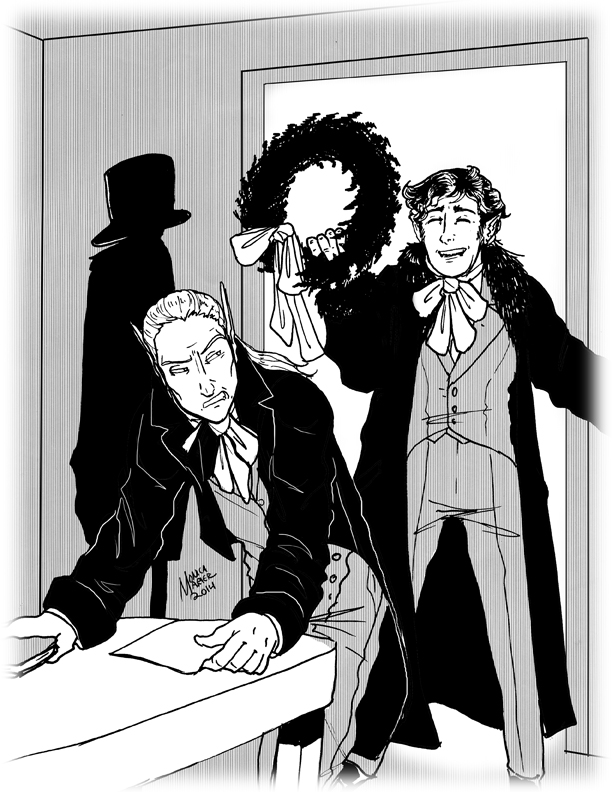
`A merry Christmas, uncle! God save you!’ cried a cheerful voice. It was the voice of Scrooge’s nephew, who came upon him so quickly that this was the first intimation he had of his approach.

`Bah!’ said Scrooge, `Humbug!’

cc_02

`A merry Christmas, uncle! God save you!’

He had so heated himself with rapid walking in the fog and frost, this nephew of Scrooge’s, that he was all in a glow; his face was ruddy and handsome; his eyes sparkled, and his breath smoked again. `Christmas a humbug, uncle!’ said Scrooge’s nephew. `You don’t mean that, I am sure?’

`I do,’ said Scrooge. `Merry Christmas! What right have you to be merry? What reason have you to be merry? You’re poor enough.’

`Come, then,’ returned the nephew gaily. `What right have you to be dismal? What reason have you to be morose? You’re rich enough.’

Scrooge having no better answer ready on the spur of the moment, said `Bah!’ again; and followed it up with `Humbug.’

`Don’t be cross, uncle!’ said the nephew.

`What else can I be,’ returned the uncle, `when I live in such a world of fools as this? Merry Christmas! Out upon merry Christmas! What’s Christmas time to you but a time for paying bills without money; a time for finding yourself a year older, but not an hour richer; a time for balancing your books and having every item in ’em through a round dozen of months presented dead against you? If I could work my will,’ said Scrooge indignantly, `every idiot who goes about with “Merry Christmas” on his lips, should be boiled with his own pudding, and buried with a stake of holly through his heart. He should!’

`Uncle!’ pleaded the nephew.

`Nephew!’ returned the uncle sternly, `keep Christmas in your own way, and let me keep it in mine.’

`Keep it!’ repeated Scrooge’s nephew. `But you don’t keep it.’

`Let me leave it alone, then,’ said Scrooge. `Much good may it do you! Much good it has ever done you!’

`There are many things from which I might have derived good, by which I have not profited, I dare say,’ returned the nephew. `Christmas among the rest. But I am sure I have always thought of Christmas time, when it has come round — apart from the veneration due to its sacred name and origin, if anything belonging to it can be apart from that — as a good time; a kind, forgiving, charitable, pleasant time: the only time I know of, in the long calendar of the year, when men and women seem by one consent to open their shut-up hearts freely, and to think of people below them as if they really were fellow-passengers to the grave, and not another race of creatures bound on other journeys. And therefore, uncle, though it has never put a scrap of gold or silver in my pocket, I believe that it has done me good, and will do me good; and I say, God bless it!’

The clerk in the Tank involuntarily applauded. Becoming immediately sensible of the impropriety, he poked the fire, and extinguished the last frail spark for ever.

`Let me hear another sound from you,’ said Scrooge, `and you’ll keep your Christmas by losing your situation! You’re quite a powerful speaker, sir,’ he added, turning to his nephew. `I wonder you don’t go into Parliament.’

`Don’t be angry, uncle. Come! Dine with us tomorrow.’

Scrooge said that he would see him — yes, indeed he did. He went the whole length of the expression, and said that he would see him in that extremity first.

`But why?’ cried Scrooge’s nephew. `Why?’

`Why did you get married?’ said Scrooge.

`Because I fell in love.’

`Because you fell in love!’ growled Scrooge, as if that were the only one thing in the world more ridiculous than a merry Christmas. `Good afternoon!’

`Nay, uncle, but you never came to see me before that happened. Why give it as a reason for not coming now?’

`Good afternoon,’ said Scrooge.

`I want nothing from you; I ask nothing of you; why cannot we be friends?’

`Good afternoon,’ said Scrooge.

`I am sorry, with all my heart, to find you so resolute. We have never had any quarrel, to which I have been a party. But I have made the trial in homage to Christmas, and I’ll keep my Christmas humour to the last. So A Merry Christmas, uncle!’

`Good afternoon,’ said Scrooge.

`And A Happy New Year!’

`Good afternoon,’ said Scrooge.

His nephew left the room without an angry word, notwithstanding. He stopped at the outer door to bestow the greetings of the season on the clerk, who cold as he was, was warmer than Scrooge; for he returned them cordially.

`There’s another fellow,’ muttered Scrooge; who overheard him: `my clerk, with fifteen shillings a week, and a wife and family, talking about a merry Christmas. I’ll retire to Bedlam.’

ADVENT CALENDAR DAY 2

Standard

A Christmas Carol

By Charles Dickens

Illustrations by Monica Marier

Stave One: Marley’s Ghost

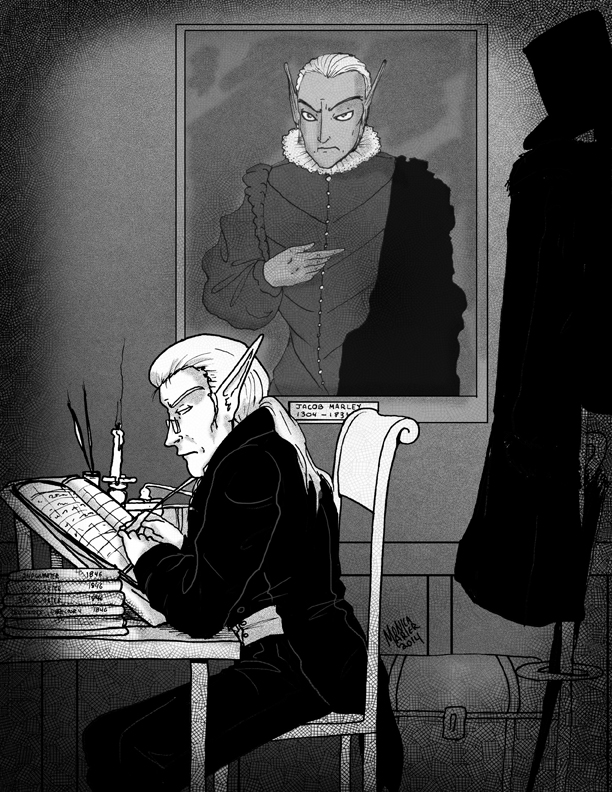
Marley was dead: to begin with. There is no doubt whatever about that. The register of his burial was signed by the clergyman, the clerk, the undertaker, and the chief mourner. Scrooge signed it. And Scrooge’s name was good upon ‘Change, for anything he chose to put his hand to.

cc_01

Old Marley was as dead as a door-nail.

Old Marley was as dead as a door-nail.

Mind! I don’t mean to say that I know, of my own knowledge, what there is particularly dead about a door-nail. I might have been inclined, myself, to regard a coffin-nail as the deadest piece of ironmongery in the trade. But the wisdom of our ancestors is in the simile; and my unhallowed hands shall not disturb it, or the Country’s done for. You will therefore permit me to repeat, emphatically, that Marley was as dead as a door-nail.

Scrooge knew he was dead? Of course he did. How could it be otherwise? Scrooge and he were partners for I don’t know how many years. Scrooge was his sole executor, his sole administrator, his sole assign, his sole residuary legatee, his sole friend, and sole mourner. And even Scrooge was not so dreadfully cut up by the sad event, but that he was an excellent man of business on the very day of the funeral, and solemnised it with an undoubted bargain. The mention of Marley’s funeral brings me back to the point I started from. There is no doubt that Marley was dead. This must be distinctly understood, or nothing wonderful can come of the story I am going to relate. If we were not perfectly convinced that Hamlet’s Father died before the play began, there would be nothing more remarkable in his taking a stroll at night, in an easterly wind, upon his own ramparts, than there would be in any other middle-aged gentleman rashly turning out after dark in a breezy spot — say Saint Paul’s Churchyard for instance — literally to astonish his son’s weak mind.

Scrooge never painted out Old Marley’s name. There it stood, years afterwards, above the warehouse door: Scrooge and Marley. The firm was known as Scrooge and Marley. Sometimes people new to the business called Scrooge Scrooge, and sometimes Marley, but he answered to both names. It was all the same to him.

Oh! But he was a tight-fisted hand at the grind- stone, Scrooge! a squeezing, wrenching, grasping, scraping, clutching, covetous, old sinner! Hard and sharp as flint, from which no steel had ever struck out generous fire; secret, and self-contained, and solitary as an oyster. The cold within him froze his old features, nipped his pointed nose, shrivelled his cheek, stiffened his gait; made his eyes red, his thin lips blue; and spoke out shrewdly in his grating voice. A frosty rime was on his head, and on his eyebrows, and his wiry chin. He carried his own low temperature always about with him; he iced his office in the dogdays; and didn’t thaw it one degree at Christmas.

External heat and cold had little influence on Scrooge. No warmth could warm, no wintry weather chill him. No wind that blew was bitterer than he, no falling snow was more intent upon its purpose, no pelting rain less open to entreaty. Foul weather didn’t know where to have him. The heaviest rain, and snow, and hail, and sleet, could boast of the advantage over him in only one respect. They often `came down’ handsomely, and Scrooge never did.

Nobody ever stopped him in the street to say, with gladsome looks, `My dear Scrooge, how are you? When will you come to see me?’ No beggars implored him to bestow a trifle, no children asked him what it was o’clock, no man or woman ever once in all his life inquired the way to such and such a place, of Scrooge. Even the blind men’s dogs appeared to know him; and when they saw him coming on, would tug their owners into doorways and up courts; and then would wag their tails as though they said, `No eye at all is better than an evil eye, dark master!’

But what did Scrooge care! It was the very thing he liked. To edge his way along the crowded paths of life, warning all human sympathy to keep its distance, was what the knowing ones call `nuts’ to Scrooge.

Once upon a time — of all the good days in the year, on Christmas Eve — old Scrooge sat busy in his counting-house. It was cold, bleak, biting weather: foggy withal: and he could hear the people in the court outside, go wheezing up and down, beating their hands upon their breasts, and stamping their feet upon the pavement stones to warm them. The city clocks had only just gone three, but it was quite dark already — it had not been light all day — and candles were flaring in the windows of the neighbouring offices, like ruddy smears upon the palpable brown air. The fog came pouring in at every chink and keyhole, and was so dense without, that although the court was of the narrowest, the houses opposite were mere phantoms. To see the dingy cloud come drooping down, obscuring everything, one might have thought that Nature lived hard by, and was brewing on a large scale.

The door of Scrooge’s counting-house was open that he might keep his eye upon his clerk, who in a dismal little cell beyond, a sort of tank, was copying letters. Scrooge had a very small fire, but the clerk’s fire was so very much smaller that it looked like one coal. But he couldn’t replenish it, for Scrooge kept the coal-box in his own room; and so surely as the clerk came in with the shovel, the master predicted that it would be necessary for them to part. Wherefore the clerk put on his white comforter, and tried to warm himself at the candle; in which effort, not being a man of a strong imagination, he failed.

ADVENT CALENDAR DAY 1

Standard

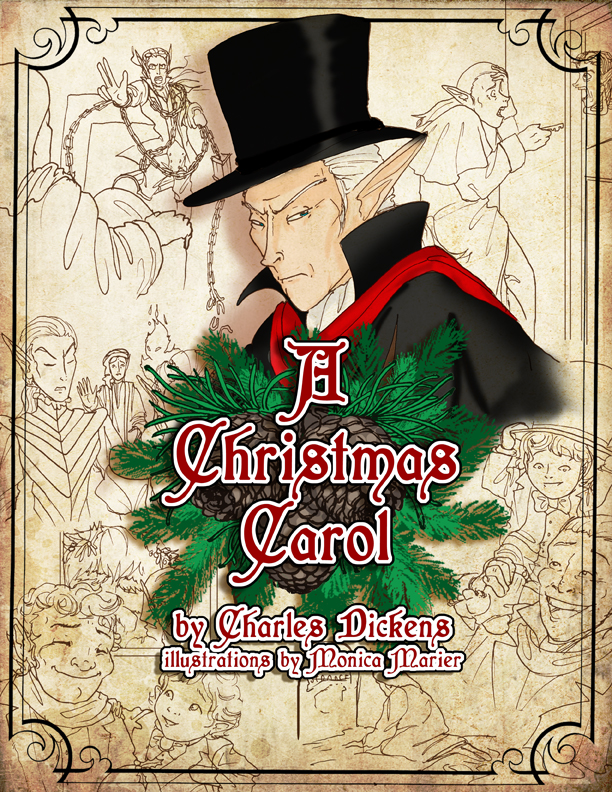
Okay, here we go!  I’m going to embark on a project I’ve wanted to do for years. Just for you, my friends, this Holiday Season, I present to you: an illustrated Christmas Carol. Everyday until Christmas Day (when—fingers crossed!—I’ll put it all together) there will be a new fantasy-themed illustration and a section of text from Charles Dickens’ most famous work. I hope you enjoy it. Here’s today’s art: the cover.

cover

Character Spotlight: Avery Bachhaussen

Standard

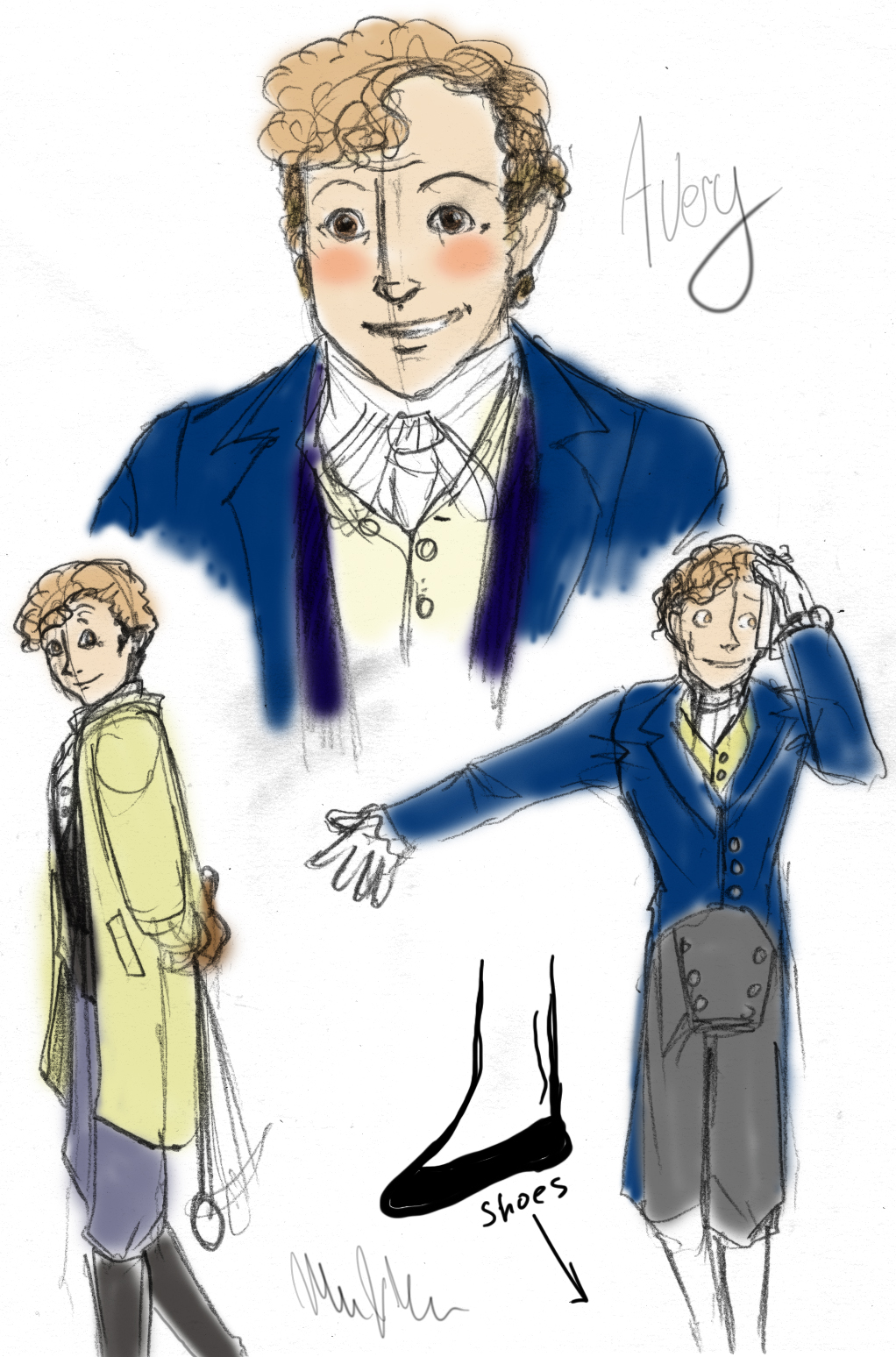
One of the classic rules of writing is that if you want your character to have extraordinary adventures outside of the ordinary you give him a) freedom, b) drive or c) money. Linus running for Union President, like he did in Runs in Good Condition happened totally organically, since I actually hate politics and never thought I’d write about an election. But as soon as I knew that he HAD to run there was a polite knock at my brain and there was Avery again saying, “Um, excuse me? Can I be of any service to you?”

 Avery Bachhaussen


Avery first made his appearance at the very end of Must Love Dragons. He was just a Ranger on Linus’ side who helps him out a bit. I had no idea that he was actually going to continue on into The Linus Saga as a character. He’s just one of those ideas that took on a life of their own.

When he started out in my brain he was just an extra that was a carbon copy of Crispin Bonham-Carter’s version of Mr. Bingley in the 1992 production of Pride and Prejudice. But even if he looks identical to that in my head, he’s taken on a character of his own in the process of writing him and turned out far more interesting than I had intended.

Avery is a privileged only son of Old Money, on par with hotel magnates and electronic company CEOs. He’s your classic nice guy. He always wants to help, he’s passionate about causes he believes in and never wants to have anyone mad at him.

But like the standard ‘nice guy’ of today he has a lot of flaws. He’s naïve and easily led by other people’s opinions, ready to accept them without consulting the facts or his own feelings. He takes everything at face value and is quick to divide the world into black and white, until he gets another opinion to zealously believe in. So, basically he’s that guy on Facebook that will share every “share if you want to stop/ help/support____” post, and writes “THIS” about articles outlining the latest injustice without actually reading them or checking the sources—the headline’s pretty much said everything, right?

So, Avery is a sweetheart, but he doesn’t have a single original thought in his brain. Unfortunately that’s starting to clash with his new family. He has a young wife and a (pending) child—another decision he made because he followed societal norms. The problem is that no one is telling him how to do this “family” thing or how to feel about it. There’s no one to form his opinions for him and no one to get him worked up into a fervor about it. How is he going to keep things going without passion for his loved one—passion he instead devotes to his work?

I’ll have to find out in a future book, I guess.


FUN FACTS:

*The one time Avery showed the world he was his own man was when he chose to marry someone without money. It was his one act of rebellion against his family, who still constantly criticize his involvement in civil affairs.

*Avery’s very altruistic and donates regularly to causes like, homes for orphans, widows pensions, schools, and apprenticeship fees for boys who might not otherwise be able to afford them.

*He’s also slightly patriarchal, willing to defer to men and let them lead him around by the horns but never thinking that women or children have anything of value to contribute. He himself is unaware of this and would be quite shocked if you told him this.

*Avery became a Ranger to get out going to parties and stuffy mansions. He enjoys spending time outdoors and is a formidable hunter and horseman.

Character Spotlight: Thisbe Weedchacker

Standard

We’re on to Linus’ brood-child number three with the irascible middle-child Thisbe.

Image

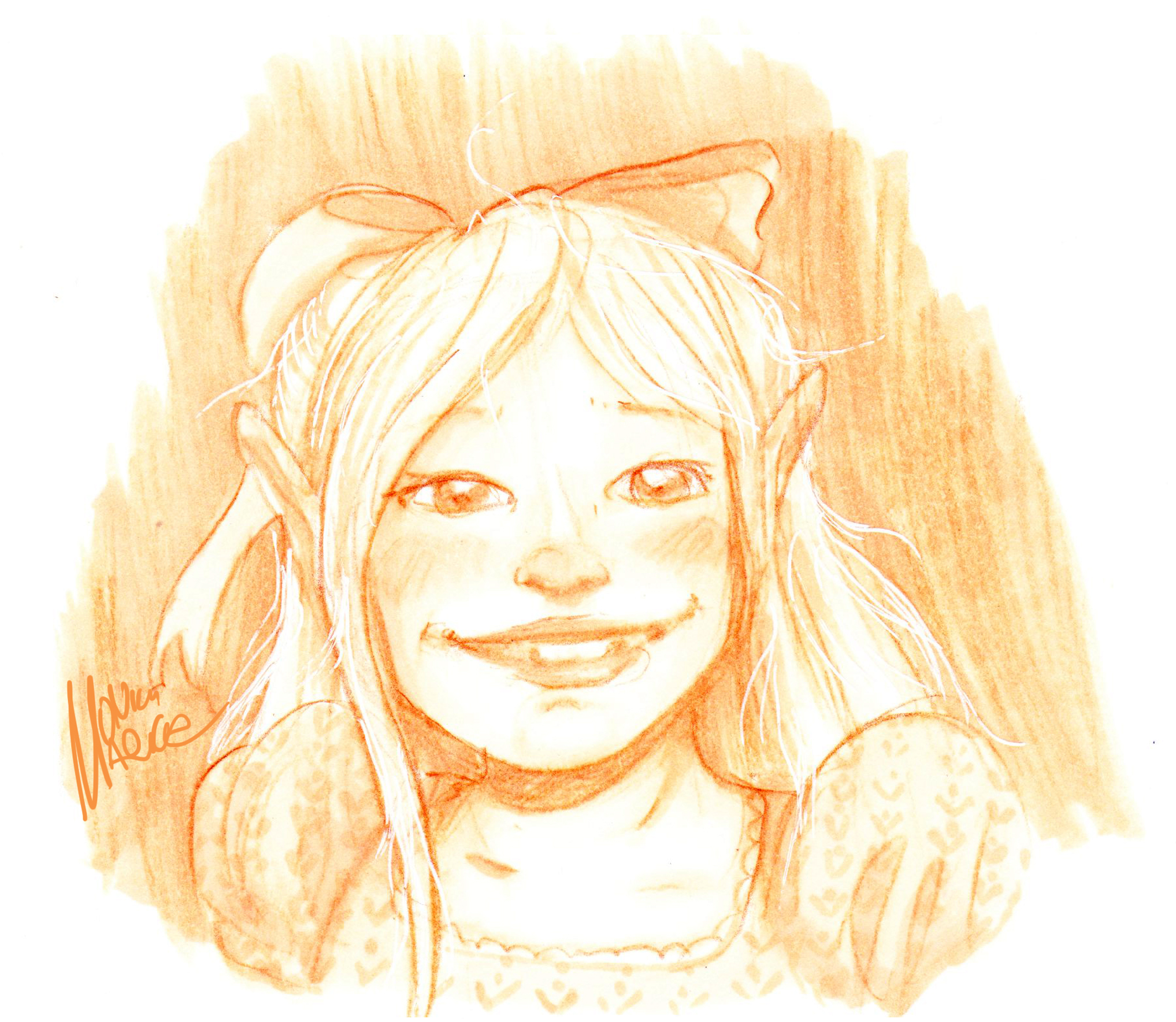
Thisbe Weedwhacker by Monica Marier

We get to know Thisbe in Runs in Good Condition. She’s in every way a typical middle child of a large family. She chafes at the authority her older sister, Irene, has over her and in retaliation likes to exploit any weaknesses in her sister’s armor. Thisbe is clever and has a sharp tongue and even sharper ears. A born tattle-tale with a thirst for gossip, she’s always the first to tease a sibling over a supposed crush or troubles with classmates in school, or any trials like new glasses, stunted growth, pimples, unruly hair, or (in Irene’s case) being skinny and flat-chested. She also terrorizes her younger syblings in an attempt to wrest control from Irene and bosses the life out of them.

Linus and Deirdre take a lot of her antics in stride. Linus in particular is familiar with sisters fighting like cats in a sack and turning into little generals. He’s at a loss as to how to deal with Irene, however, and lets a lot of her antics go unchallenged and ignored, which is precisely what Thisbe doesn’t want. She constantly feels at odds with her siblings for attention and feels like the lowest rung on the ladder. Her hard work goes unnoticed because Carson and Irene have done it first and done it better, yet she isn’t coddled and comforted like Orin,Fia, and the babies because she’s too old. 

Her only chance to shine is in her innate gift of keeping house. Thisbe is better than her parents and her sister at cooking, cleaning, sewing, and in addition is a champion knitter and crocheter. And yet she feels ashamed that being a good housewife and mother is her highest ambition, as other siblings go on about university careers, and travel. She’s not a bad kid by any means; she’s industrious, generous, open, and honest. Her desire for attention, however, is going to lead to her lashing out, especially in my next book.

FUN FACTS:

*Irene adores and idolizes her brother Carson, even though she’s closer to Orin in age and tastes.

*Irene has a huge crush on Morfindel, and most of her acting out in The Linus Saga, is done to get Morfindel to notice her.

*She learned to sew without her parents knowing, simply because she wanted her hand-me-down dresses from her sister to look like it was a different dress. Without asking, she managed to sun bleach the dress, add a lace collar, and embroider it with pink thread. Her father actually scolded her because he thought she had stolen a dress, until Thisbe proved it was her own work. After that, Linus made sure she was well-supplied with any wool, thread and lawn he could get at a good price.

*While Thisbe loves to knit and make pretty dresses for herself, most of her work is selflessly made for her family members. She makes the most things for Carson (and later on, Morfindel), and makes the fewest things for Irene. The pieces she makes for Irene are usually intricate and advanced pieces. These are mostly to rub in Irene’s face the fact that she can’t knit or sew.

* It’s been mentioned that the Weedwhackers have been hosts to several cats over the years. These were all strays that were brought home by Thisbe. 

*Thisbe has already decided that her husband is going to be a shopkeeper with brown hair and a cleft chin. Their children will be named Garth and Louisa and they’ll have a white cat named Marzipan.


That’s it for Thisbe. Next week we’ll look at Old Soul, Orin Weedwhacker.

If you enjoyed this post, please consider donating to my fund for a new computer so I can keep making more.

Thanks for reading!